

You walk into a restaurant, your service dog calm and focused at your side. The host stops you. “Do you have papers for that dog?” It’s a question nearly three-quarters of service dog owners say they’ve been asked, and it’s one that violates federal law. If you’ve ever been caught off guard by it, you’re not alone.
This guide breaks down exactly what is and isn’t legal when it comes to service dog verification:
- What the ADA says about proof and documentation
- The only two questions anyone can legally ask you
- Your rights in stores, hotels, restaurants, and housing
- What to do if you’re wrongfully denied access
- How proper training prevents most access issues
At Shultz K9, we train service dogs and working dogs at our Fort Lauderdale facility to perform confidently in any public setting. When your dog’s training speaks for itself, the proof question rarely comes up.
What the ADA Says About Proof
Let’s get this out of the way: there is no such thing as official service dog papers. The Americans with Disabilities Act does not require you to provide documentation, carry certification, or show any form of ID to prove your dog is a service animal. Covered entities may not require documentation, such as proof that the animal has been certified, trained, or licensed as a service animal, as a condition for entry.
That means no business, no state or local government, and no employee can legally demand that you hand over service dog papers before allowing you inside.
What “Proof” Actually Exists Under Federal Law
Here’s the reality: none. There is no federal registry. No government-issued service dog certification. No official database. There are individuals and organizations that sell service animal certification or registration documents online. These documents do not convey any rights under the ADA, and the Department of Justice does not recognize them as proof that the dog is a service animal.
So what does determine whether a dog is a service animal? Two things:
- The dog has been individually trained to perform tasks that are task directly related to a person’s disability
- The dog is under the handler’s control in public places
That’s it. No paperwork. No service vest. No medical documentation. The Americans with Disabilities Act focuses entirely on what the dog has been trained to do, not what documents the handler can produce.
ADA vs. Other Laws
It’s worth noting that other laws have different rules around documentation. The Air Carrier Access Act, for example, allows commercial airlines to request a DOT form attesting to your service dog’s health, behavior, and training before a flight. And the Fair Housing Act allows housing providers to request documentation of a person’s disability when it isn’t obvious, particularly for emotional support animals.
But when it comes to walking into a store, restaurant, or any public accommodation? The ADA is what applies. And under ADA laws, no one can request that you provide documentation of any kind.
Pro tip:Those online registries selling certificates and ID cards for $50 to $200? They’re selling peace of mind, not legal protection. Save your money and invest in actual training instead.
The Two Questions Anyone Can Ask
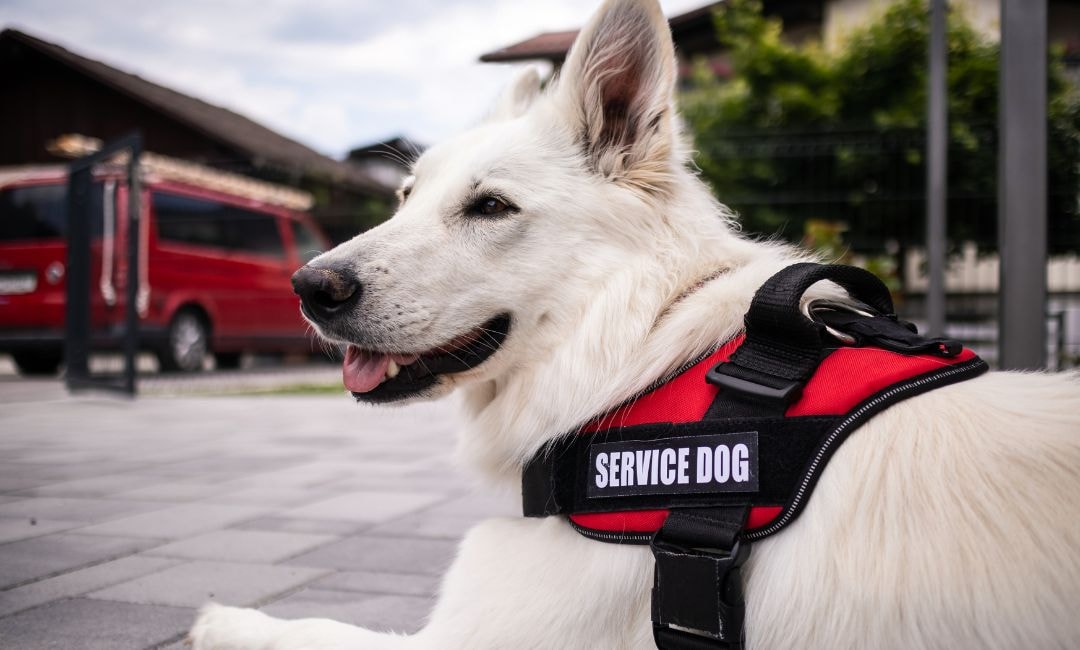
This is the most misunderstood part of service dog rights. Many businesses think they can ask whatever they want. Many handlers think nothing can be asked. Both are wrong.
The Legal Standard
When it is not obvious what service an animal provides, only limited inquiries are allowed. Staff may ask exactly two questions:
- “Is this a service animal required because of a disability?”
- “What work or task has the dog been trained to perform?”
These two questions are the only tools businesses have to determine if the dog is a service animal. They apply to every public accommodation, every state or local government facility, and every business covered by the Americans with Disabilities Act.
What’s Off-Limits
The list of things people cannot ask or request is longer than what they can. Staff cannot:
- Ask about the nature or details of your disability
- Request medical documentation or a doctor’s note
- Require the dog demonstrate its task on the spot
- Demand a certification, registration, or ID card
- Ask to see the service dog papers of any kind
- Insist that the dog wear a vest or service vest as a condition for entry
Staff cannot ask about the person’s disability, require medical documentation, require a special identification card or training documentation for the dog, or ask that the dog demonstrate its ability to perform the work or task.
What If They Ask Anyway?
It happens. A lot. When someone asks you legal questions that go beyond those two permitted inquiries, you’re not required to answer. Stay calm, reference the ADA, and know that refusing to answer illegal questions is not grounds for denying you access.
That said, how you handle the moment matters. A brief, confident response like “Yes, this is my service dog. He’s trained to assist with my disability” is usually enough to move past the interaction. Getting combative rarely helps.
Pro tip:Some service dog handlers carry a small ADA rights card in their wallet. It’s not legally required, but it can quickly educate an uninformed employee without turning the interaction into a confrontation.
Your Rights in Stores, Hotels, and Housing
Your service dog rights don’t change based on the type of establishment you’re entering. But the laws that protect you can vary depending on the setting. Here’s how it breaks down.
Stores and Restaurants
Under the Americans with Disabilities Act, businesses that serve the public must allow service animals to accompany people with disabilities in all areas where other customers are allowed. This includes restaurants, retail stores, movie theaters, gyms, and anywhere else the general public can go.
Businesses cannot:
- Charge you extra fees or deposits because of your service animal’s presence
- Isolate you from other patrons or seat you in a separate area
- Deny entry because other customers are uncomfortable with or allergic to dogs
- Require your dog wear a service dog vest
People with disabilities who use service animals cannot be isolated from other patrons, treated less favorably than other patrons, or charged fees that are not charged to other patrons without animals.
The only exception? If the animal’s presence would create a fundamental alteration to the nature of the service being provided, such as bringing a dog into a sterile environment, such as an operating room.
Hotels
Hotels follow the same ADA rules as any other public accommodation. They must allow your service dog in your room and in all public areas of the property. No pet fees. No pet deposits. No breed restrictions.
However, if your service dog causes damage to the room, the hotel can charge you for it, the same way they’d charge any guest for property damage. The key distinction is that they cannot charge you simply for having a service animal present.
Housing and Residential Properties
Housing operates under different rules. The Fair Housing Act protects disabled individuals in residential properties, requiring housing providers to make reasonable accommodations for both service dogs and emotional support animals. This applies to apartments, condos, public housing programs, and most private rentals.
Under the Fair Housing Act, landlords cannot:
- Deny you housing because of your service animal
- Charge pet deposits or pet fees for a service dog
- Apply breed or size restrictions to service animals
- Require your dog wear a vest or carry identification
However, housing providers can ask for documentation of your disability when it isn’t obvious. This is where the rules differ from stores and restaurants. In a housing context, a landlord may request a letter from a healthcare provider confirming that you have a disability and that the animal assists with it. They still cannot ask for specific diagnoses or detailed medical records.
Air Travel
Commercial airlines fall under the Air Carrier Access Act, not the ADA. Under this federal law, airlines must allow trained service dogs in the cabin at no extra charge. But they can require you to fill out a DOT Service Animal Air Transportation Form before your flight. This form attests to your dog’s training, health, and behavior.
Emotional support animals are not covered by the Air Carrier Access Act. Since 2021, most airlines no longer recognize ESAs for cabin access. Only dogs individually trained to perform specific tasks for a person with a disability qualify.
| Setting | Governing Law | Can They Ask for Proof? | Documentation Required? |
|---|---|---|---|
| Stores / Restaurants | ADA | Only two questions | No |
| Hotels | ADA | Only two questions | No |
| Housing | Fair Housing Act | Can request disability verification | Yes (when disability isn’t obvious) |
| Airlines | Air Carrier Access Act | Can require a DOT form | Yes |
| Federal agencies/programs | Section 504 | Varies | Depends on the agency |
What to Do If You’re Denied Access
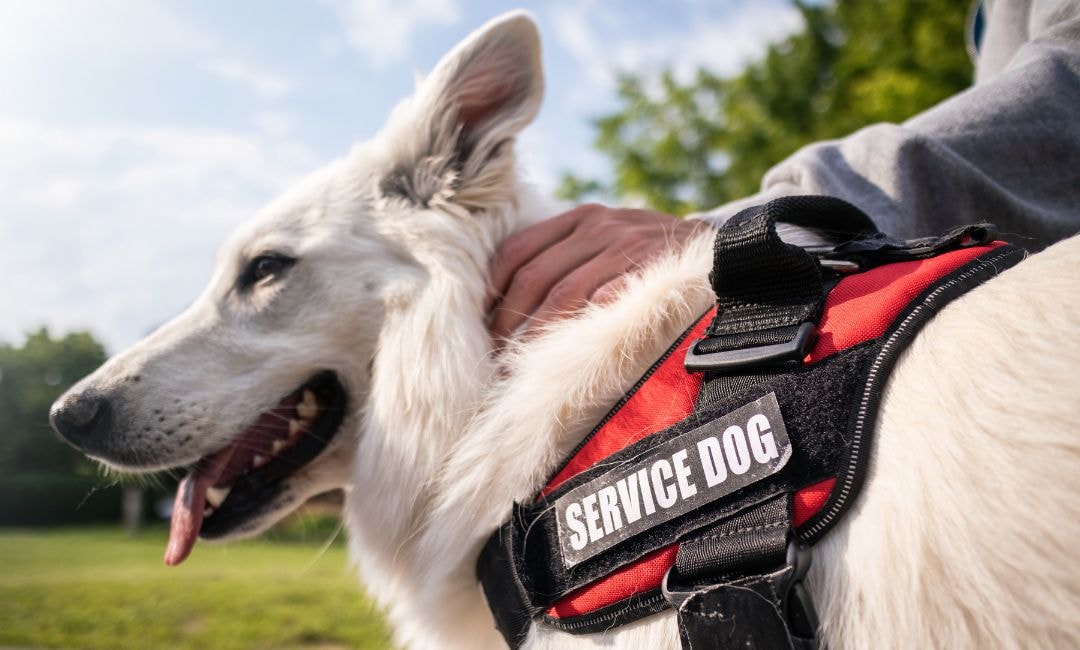
It shouldn’t happen. But it does. Knowing how to respond in the moment can make the difference between a resolved misunderstanding and a full-blown violation of your service dog rights.
Stay Calm and Educate
Most access denials aren’t malicious. They come from employees who simply don’t understand ADA laws. When someone tells you your dog can’t come in, or asks you to provide documentation, try this approach:
- State clearly: “This is my service dog. Under the ADA, I’m not required to show documentation.”
- Reference the two questions: Let them know they can ask if the dog is a service animal required because of a disability, and what work or task has the dog been trained to perform.
- Ask for a manager: If the employee doesn’t budge, escalate calmly. Managers are more likely to understand their obligations under federal law.
Resist the urge to get confrontational. You’re in the right, and staying composed makes it easier to resolve the situation on the spot.
Know When a Business Can Ask You to Leave
There are exactly two justifiable reasons a business can request that a service dog handler remove their animal:
- The dog is out of control, and the handler does not take effective action to control it (for example, acting aggressively, barking nonstop, or lunging at people)
- The dog is not housebroken
Even in these situations, the business must still offer you the opportunity to access their goods and services without the animal. They can’t just turn you away entirely.
File a Complaint
If you’ve been wrongfully denied access and the situation wasn’t resolved on-site, you have options:
- File a complaint with the U.S. Department of Justice at ada.gov. This covers businesses and state or local governments.
- Contact your state’s civil rights office. Many local governments have their own enforcement mechanisms for disability discrimination.
- Consult a disability rights attorney. If the denial caused significant harm or was part of a pattern, you may have grounds for legal action.
Pro tip:Document everything. Write down the date, time, location, names of employees involved, and exactly what was said. This record is critical if you decide to file a formal complaint.
Training Prevents Most Access Issues
Here’s something most articles on this topic won’t tell you. The real reason service dog handlers get questioned, stopped, and denied access isn’t always about ignorant employees. Sometimes it’s about the dog.
A service animal that pulls on the leash, sniffs merchandise, barks at other customers, or wanders away from its handler raises obvious red flags. It makes people wonder if the dog is a service animal at all. And while that doesn’t give anyone the right to demand proof, it does invite more scrutiny.
What Well-Trained Service Dogs Look Like
A properly trained service dog should be virtually invisible in public places. That means:
- Walking calmly at the handler’s side without pulling or lunging
- Ignoring food, other animals, and distractions from other patrons
- Settling quietly under a table or beside a chair for extended periods
- Responding to commands promptly and reliably
- Performing its specific tasks on cue without hesitation
When a dog performs at this level, staff rarely question whether it belongs. The dog’s behavior becomes the proof. No one asks for service dog papers when the animal is clearly trained to perform its job with precision.
Psychiatric Service Dogs Need the Same Standard
There’s a common misconception that psychiatric service dogs don’t need the same level of public behavior training as mobility or guide dogs. That’s wrong. Whether a dog is trained to interrupt a panic attack, remind a person to take medication, or perform deep pressure therapy, it still needs to behave flawlessly in public.
The task the dog performs may be less visible to people around you. That’s exactly why behavior and obedience training are even more important for psychiatric service dogs. When the disability isn’t obvious, the dog’s composure is what signals legitimacy to everyone in the room.
Why Professional Training Makes a Difference
The ADA doesn’t require professional training. You can train your own service dog. But there’s a significant gap between a dog that technically qualifies and one that thrives in high-pressure environments. Professional trainers understand how to build a dog that stays calm in crowded spaces, responds under stress, and performs tasks reliably in real-world conditions.
At Shultz K9, we train service dogs and working dogs to perform at an elite level. Our Fort Lauderdale team builds dogs that are focused, composed, and ready for any environment, from busy airports to quiet restaurants. When your dog’s training is dialed in, access issues become rare. The dog’s behavior does the talking.
Train With Confidence at Shultz K9
No one should have to argue their way into a grocery store or hotel lobby. The law is clear: you don’t need papers, certifications, or a vest to prove your service dog is legitimate. What you do need is a dog that’s trained well enough to make the question irrelevant.
Here are the key takeaways:
- No proof is required under the ADA. Businesses cannot demand documentation, certification, or service dog papers as a condition for entry
- Only two questions are legal. Is the dog a service animal required because of a disability, and what task has the dog been trained to perform?
- Different settings follow different rules. The ADA covers public places, the Fair Housing Act covers housing, and the Air Carrier Access Act covers airlines
- Access denials can be reported. File complaints with the DOJ or your state’s civil rights office
- Training is your best protection. A dog that performs flawlessly in public rarely gets questioned
If you’re preparing a service dog for real-world work, or your current dog needs stronger obedience in public settings, our team at Shultz K9 can help. We train dogs at our Fort Lauderdale facility to be calm, reliable, and ready for anything.
If you’re preparing a dog for service work, or if your current service dog needs stronger public behavior skills, contact our team or call us at (954)-552-4282. We also offer financing with plans starting at $199/month.
FAQs
How do you prove you have a service dog?
You don’t have to. The American Disability Act does not require any form of proof, certification, or registration. The only verification allowed is the two ADA questions about whether the dog is a service animal and what task it performs. No papers, no ID cards, no demonstrations.
Why is it illegal to ask about service dogs?
It’s not illegal to ask anything. It’s illegal to ask questions beyond the two permitted by the ADA. Asking about someone’s disability, demanding medical records, or requiring documentation violates federal law because it discriminates against people with disabilities. The law protects handler privacy while still letting businesses determine if a dog qualifies.
Can cops ask for proof of a service animal?
Law enforcement officers follow the same ADA rules as everyone else. They can ask the two permitted questions but cannot demand certification, registration, or medical documentation. However, if a dog is acting aggressively or is out of control, officers can intervene on safety grounds regardless of the dog’s status.
Can a hotel ask for proof that your dog is a service dog?
No. Hotels are public accommodations under the ADA and follow the same two-question rule. They cannot charge pet fees, require documentation, or deny access because people bring a service dog without a vest. They can charge for any property damage the dog causes, just like they would for any guest.
What is the Georgia law about service dogs?
Georgia law refers to service dogs as “assistance dogs” and requires that they be trained by a licensed or certified person, organization, or agency to perform physical tasks for a physically disabled person. This is narrower than the ADA, which also covers psychiatric service dogs and doesn’t require professional training.
Federal law overrides state law where it offers broader protections, so ADA rules still apply across all federal programs and public places in Georgia. Denying access to a service dog handler in Georgia is a misdemeanor punishable by a fine of up to $2,000, imprisonment for up to 30 days, or both.
